Laboratory in Honeycomb: The World Beyond — Your Base's Research Heart
The laboratory in Honeycomb: The World Beyond — the heart of the base where samples are analysed, plants grow in pods, and crossbreeding research happens.
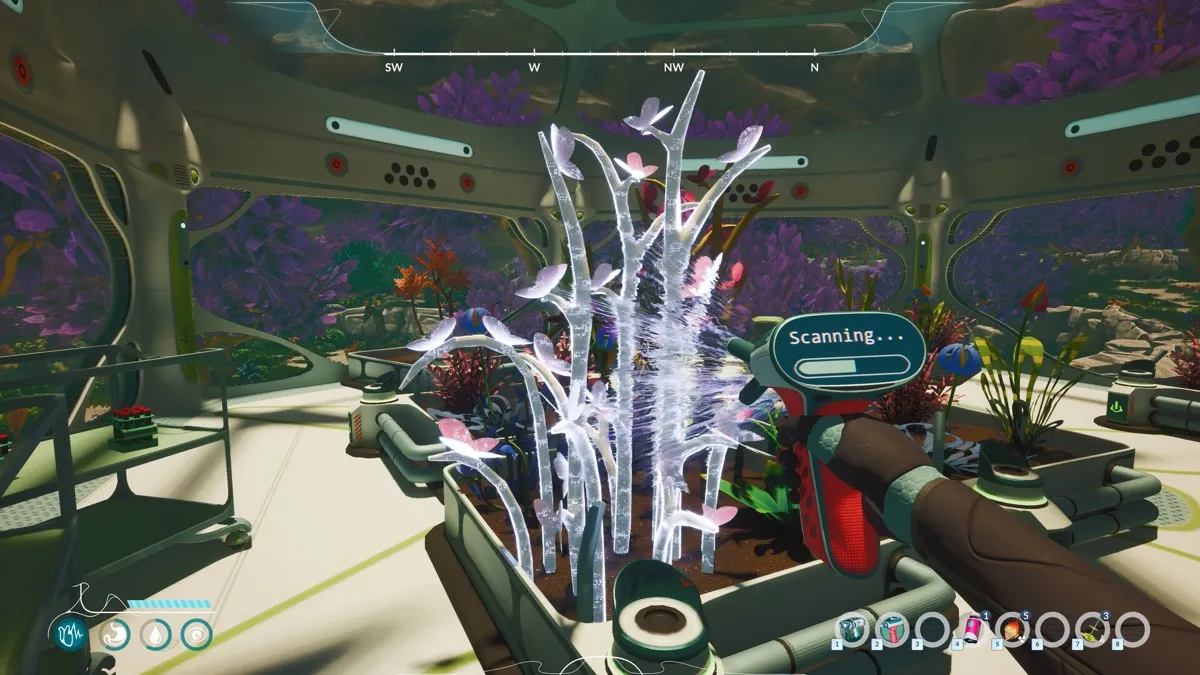
Why is the laboratory the heart of the base?
Because the official material says so, near-verbatim. The Steam page defines your base of operations as the place to “live, work, craft, and conduct experiments,” and the official site is blunter: “Your Base isn’t just a safe place; it’s where all your experiments come to life.” Everything else in base building — the plan system, the utilities — exists to keep this room running.
What happens inside the lab?
Three officially documented functions define the space:
- Sample analysis. Laboratory devices analyse the samples you collect on expeditions — the raw output of every scanning run through the creatures field guide and flora hub.
- Plant cultivation. The official site: “Create specialized grow pods for plant experiments.” The grow pod is lab equipment — the station where field botany becomes controlled research.
- Bioengineering. The Steam page’s core loop: “use bioengineering to synthesize unique plant properties and manipulate animal DNA to trigger fascinating physical changes.” This is the crossbreeding engine at the core of the game.
How does the lab connect to fieldwork?
The loop the game’s marketing describes runs both ways: fieldwork feeds the lab, and the lab re-arms fieldwork. Sota7’s three zones (see the zones guide) supply escalating materials — the Valley’s familiar staples, the Headlands’ processing-gated plants, the Pass’s strategic resources — and each zone’s flora and fauna exist, in the survey logs’ own framing, to feed research possibilities. Catalogued species open lab options; lab results send you back out for the next sample.
In practice, your first sessions look like the getting-started guide describes: scan and gather early, build the lab with IVS blueprints and drone assistance, then let the experiment queue start dictating your expedition plans.
What is still being verified?
The lab’s room-level equipment is documented by two independent source tiers that agree: a community wiki and the hands-on press walkthrough (Into Indie Games, September 10, 2026). The press walkthrough documents growbeds for food and research plants, and a strict placement rule for the bee-pipe — “there can only be one bee-pipe in a multiroom, and you can only place it in the centre” — matching the community-documented pod requirement (water, power, and a bee pipe; see crossbreeding).
Honesty box, same standard as every page on this wiki: experiment durations, exact device costs beyond those quoted above, and how animal-DNA work is performed are still open verification items, and we write them down only once sourced. One naming discrepancy is tracked rather than resolved: the press walkthrough lists an “IM Pump 1” recipe naming “Mars Filoy,” while the official survey logs document an “Earth Filoy” — whether these are variants or a transcription difference stays open until official material says so. What is documented above is the officially published function of the lab, and the building hub tracks what has been re-verified against the live game so far.
Related Articles
More from the field survey
building
Base Utilities in Honeycomb: The World Beyond — Water Pumps & Solar Power
Base utilities in Honeycomb: The World Beyond — advanced water pumps and solar panels, why the official guidance says build near water, and powering the lab.
building
Building Plan System in Honeycomb: The World Beyond — Blueprints & Drones
The building plan system in Honeycomb: The World Beyond — how IVS blueprints, the plan mode, and construction drones let you design a base without the busywork.
building
Honeycomb Base Building Guide Hub
Base building hub for Honeycomb: The World Beyond — modular Art Nouveau habitats, the laboratory, drones, utilities, and Planning Mode, all in one place.
Was this helpful?
Thanks for the feedback!