Imperial Strider in Honeycomb: The World Beyond — Headlands Deer Creature
The Imperial Strider in Honeycomb: The World Beyond — the Headlands' deer-like ungulate, its speckled two-tone coat, why it flees, and collecting its shed horns.
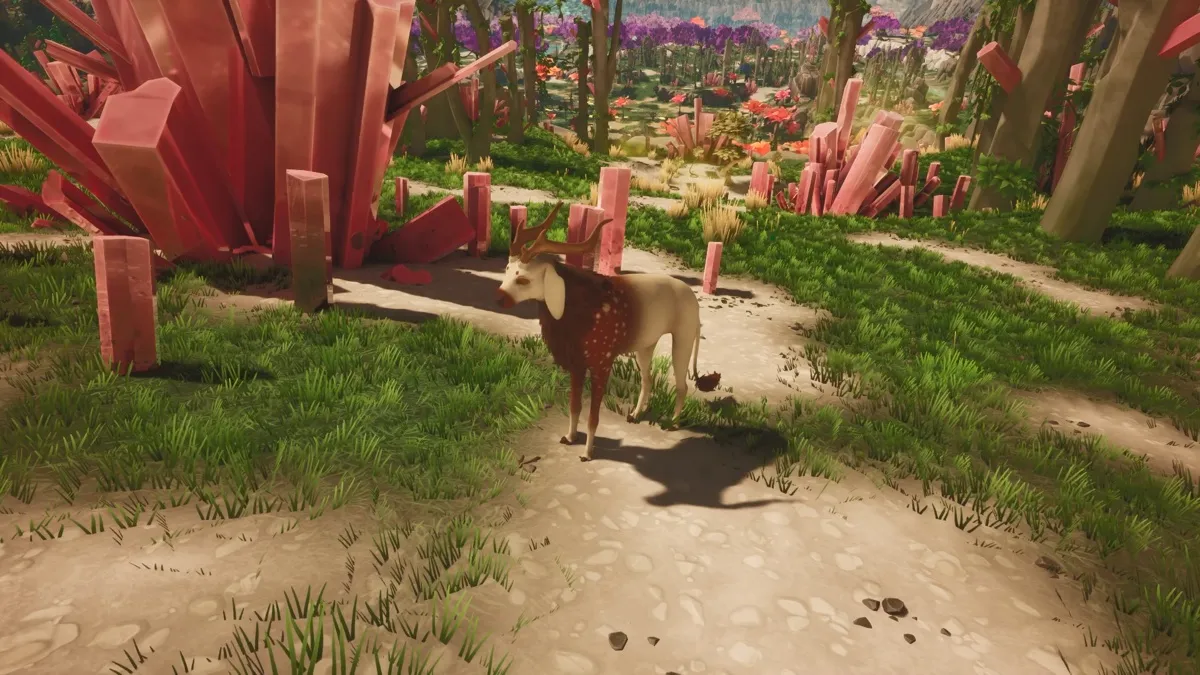
What does the Imperial Strider look like?
The Headlands’ signature silhouette: a medium-sized ungulate that carries more than a passing resemblance to a deer. Its coat is the quickest field check — the official SOTA7 Field Survey Log #3 describes a bi-colored coat shifting from deep chestnut brown at the forequarters to pale cream toward the hind, broken by white speckles along the shoulders and legs. Upward-sweeping horns, a short dark mane, and a long tufted tail complete the profile.
If you are coming from the Valley, think of it as the Headlands’ answer to Lucuma Camilla — same ungulate family feel, completely different temperament.
Where does it live?
Across the Headlands, the second Sota7 zone, where stone formations and constructed remnants replace the Valley’s marshlands (zone-by-zone orientation in the Sota7 zones guide). One habitat detail defines the hunt: Striders nest within stone formations for cover. Check the rocky outcrops and ruins first — that is both where they shelter and where their shed material collects.
How does the Imperial Strider behave?
Graceful and cautious by nature. It is not aggressive — the Headlands’ threats are elsewhere, like the pack-hunting Bronze Wox — but it flees swiftly when threatened and covers ground fast when it does. The survey’s guidance is short: approach slowly and give it room. Rush a Strider and you get one scan opportunity; walk a Strider and you can study it for as long as you like.
What makes its horns worth collecting?
The Strider sheds its horns naturally, and the shed horns are worth collecting when found because they hold real value in crafting recipes. Note the mechanics — this is a gather-what-it-leaves-behind loop, not a hunt:
- The animals shelter in stone formations, and shed horns are found on the ground — search the outcrops they nest among.
- No confrontation is ever required; the value is on the ground.
- Check outcrops on a loop — the Headlands rewards the same patient circuit-walking that the creatures hub trains you for from day one.
How does it fit the Headlands progression?
The Headlands is classified as mixed danger — a stepping stone between the Valley’s curiosity and the Pass’s hostility — and the Strider embodies the zone’s deal: richer materials, but you have to earn them with fieldcraft. Between its crafting horns, the Wox’s practical fur, and the docile Woodback Tortoise as a safe study subject, the zone’s ungulate-and-caniform roster feeds the mid-tier research that the getting-started guide builds toward.
Gallery
Related Articles
More from the field survey
guides
Honeycomb: The World Beyond Composter Guide: Biomass from Plant Matter
The Composter in Honeycomb: The World Beyond — how the Second Life quest's biomass loop works, what to feed it, and what the biomass is for.
guides
Honeycomb: The World Beyond Hoverboard Guide: Unlock, Controls & Durability
The hoverboard in Honeycomb: The World Beyond — how to unlock it, how it handles on Sota7, and how its durability scales with difficulty.
guides
Honeycomb: The World Beyond Storage & Rotting Guide: Containers & Fridges
How food rotting works in Honeycomb: The World Beyond — containers slow decay to 15%, powered fridges stop it entirely, and difficulty scales spoilage.
Was this helpful?
Thanks for the feedback!