Azurite Lonebid in Honeycomb: The World Beyond — The Pass's Gentle Giant
The Azurite Lonebid in Honeycomb The World Beyond — the deep-blue caniform of the Pass's cooler reaches, why its keen hearing beats stealth, and its craft fur.
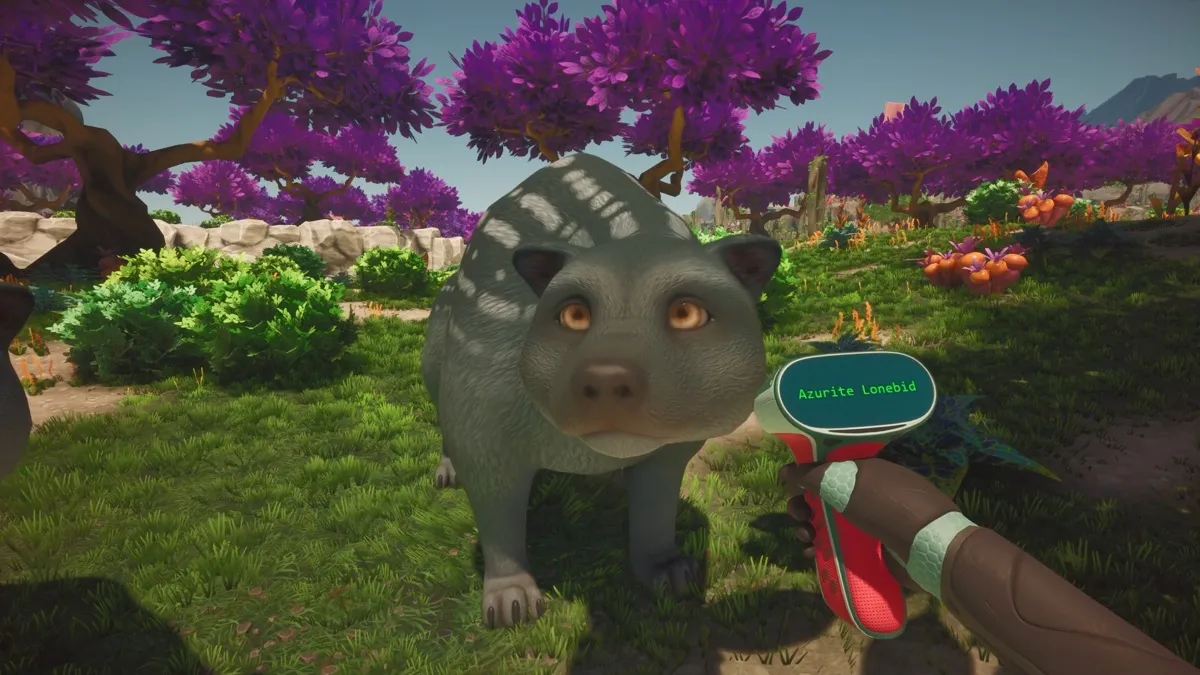
Why is the Pass’s biggest animal its friendliest?
The biggest surprise in the game’s final zone. The Pass is classified as extreme risk, an end-of-progression zone — and its cooler reaches are home to a large caniform with a muscular frame, powerful clawed forelimbs, and a deep blue coat marked with pale irregular spots. The official SOTA7 Field Survey Log #4 then delivers the twist: despite that build, the Lonebid is curious and gentle by nature. In a zone the survey describes as deliberate, contested, and consequence-heavy, its signature large animal is a friend.
How do you approach something that big?
Steadily. Not slowly — steadily. The Lonebid’s senses change the normal approach rules: its keen hearing means it will know you are there long before you get close. Every stealth habit you learned sneaking up on the Wild Green Zuma or spooking the Imperial Strider is irrelevant here, because the animal has already heard you. What it responds to is how you behave after being heard:
- Keep a constant, unhurried pace — no freezing, no rushing.
- Let its curiosity work; the species’ interest is genuine.
- Treat its size with respect — gentle does not mean small.
Where do you find one?
The cooler reaches of the Pass. The zone is small but dense, positioned between upland surfaces and extreme ecological pockets — full orientation in the Sota7 zones guide. Within the Pass it is one of the zone’s more approachable residents, unlike the armored, trust-resistant Thessalika Nango.
What do you get from the Lonebid?
Fur worth collecting for crafting recipes. The Pass’s species feed the game’s most advanced systems — late-stage progression and hybrid development, including hybrids that are not available anywhere else on Sota7 — and the Lonebid’s fur is one of them. Set against the getting-started guide’s early material chain, this is the top tier of the same economy: wool and feathers once, deep-blue fur now.
Why does a gentle animal live in the hardest zone?
Because the Pass is not hostile so much as concentrated — the survey describes species that are “not abundant in the way the Valley and Headlands are… deliberate, often contested, and worth more to your research than anything encountered before.” A confident, curious apex-adjacent animal fits that design: it does not need to be aggressive, and it does not flee like the Headlands’ deer. Meeting it is one of the Pass’s rewards — and a reminder, per the creatures hub, that on Sota7 the scan-first, engage-later rule is about reading temperament, not assuming the worst.
Gallery
Related Articles
More from the field survey
guides
Honeycomb: The World Beyond Composter Guide: Biomass from Plant Matter
The Composter in Honeycomb: The World Beyond — how the Second Life quest's biomass loop works, what to feed it, and what the biomass is for.
guides
Honeycomb: The World Beyond Hoverboard Guide: Unlock, Controls & Durability
The hoverboard in Honeycomb: The World Beyond — how to unlock it, how it handles on Sota7, and how its durability scales with difficulty.
guides
Honeycomb: The World Beyond Storage & Rotting Guide: Containers & Fridges
How food rotting works in Honeycomb: The World Beyond — containers slow decay to 15%, powered fridges stop it entirely, and difficulty scales spoilage.
Was this helpful?
Thanks for the feedback!