Gum Nibis in Honeycomb: The World Beyond — Marsh Wading Bird Guide
The Gum Nibis in Honeycomb: The World Beyond — spotting the teal-winged marsh bird, reading its territorial nest defense, and collecting its craft feathers.
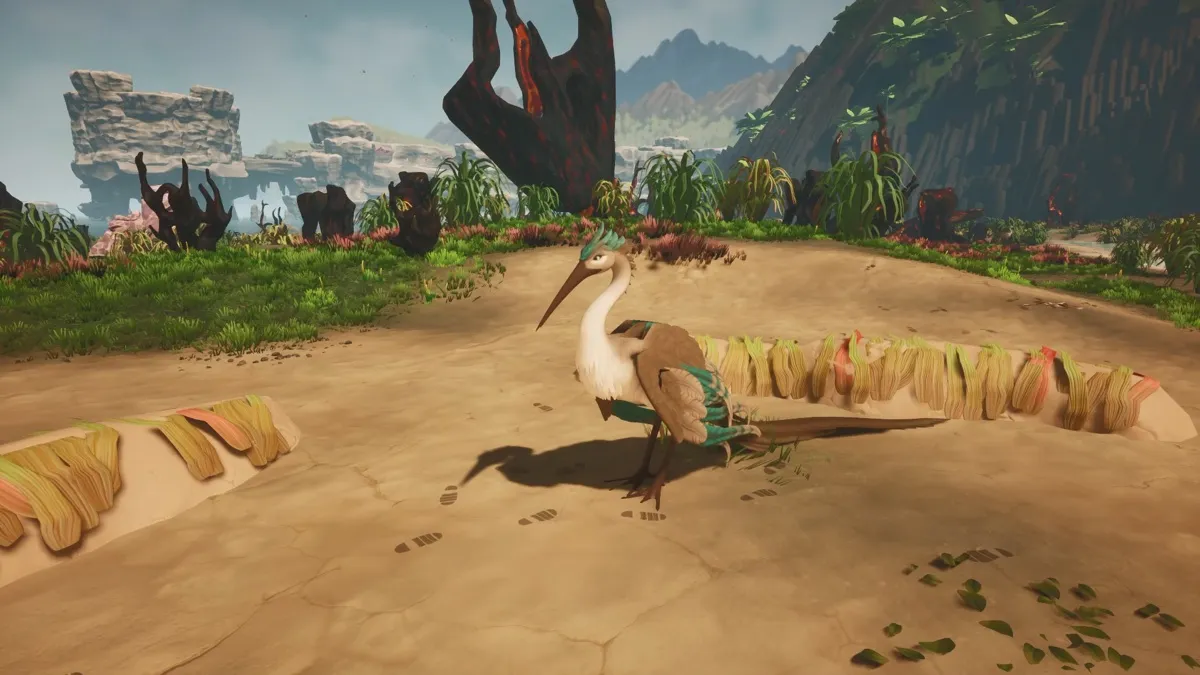
How do you spot a Gum Nibis?
From a distance, usually. The Gum Nibis is a medium-sized wading bird of the Valley’s marshes and waterways, and its trailing tail plumes make it easy to spot from far away — the official SOTA7 Field Survey Log #2 calls this usefulness out directly, because its temperament means you want to see it before it sees you. Field marks to confirm the ID:
| Feature | What to look for |
|---|---|
| Plumage | Earthy brown body, teal feathers along wings and tail |
| Beak | Long, pointed, built for foraging in shallow water |
| Head | Small feathered crest |
| Tail | Long trailing plumes — the signature marker |
Marshland orientation tips are in the Sota7 zones guide; the rest of the water-loving roster starts at the creatures hub.
Where should you look for one?
Near the Valley’s marshes and waterways. The Nibis shares the wet half of the zone with the amphibian Wild Green Zuma, but their micro-habitats differ: the Zuma hugs rocks and vegetation in damp, cooler stretches, while the Nibis stands and forages in the open shallows — which is exactly why one is hard to find and the other announces itself.
How dangerous is the Gum Nibis?
Not dangerous in the way the Valley’s one hostile species, the Scorchweaver, is — but it is territorial and protective around its nests. The survey log’s guidance is “approach with awareness” — the working variable is how close you are to a nest:
- A foraging bird away from the nest generally tolerates a calm observer.
- A bird standing guard near reeds or a nest mound will defend that spot.
- Patience here pays off — wait for the bird to resume foraging rather than testing its space.
What do you get from it?
Feathers, with real crafting value. Between the Nibis’s feathers, the wool of Lucuma Camilla, and the Zuma’s viscous secretion, the Valley hands you three distinct early animal materials — the base layer of the crafting economy that the getting-started guide walks you into before the lab work begins.
Is it a good early research target?
Yes, with a caveat: it rewards the observation habits the Valley exists to teach — read behavior, respect territory, collect when it is safe — and it punishes corner-rushing. Catalog it after the docile Camilla and you will have covered both ends of the Valley’s temperament spectrum while stockpiling two useful materials at once.
Gallery
Related Articles
More from the field survey
guides
Honeycomb: The World Beyond Composter Guide: Biomass from Plant Matter
The Composter in Honeycomb: The World Beyond — how the Second Life quest's biomass loop works, what to feed it, and what the biomass is for.
guides
Honeycomb: The World Beyond Hoverboard Guide: Unlock, Controls & Durability
The hoverboard in Honeycomb: The World Beyond — how to unlock it, how it handles on Sota7, and how its durability scales with difficulty.
guides
Honeycomb: The World Beyond Storage & Rotting Guide: Containers & Fridges
How food rotting works in Honeycomb: The World Beyond — containers slow decay to 15%, powered fridges stop it entirely, and difficulty scales spoilage.
Was this helpful?
Thanks for the feedback!