Woodback Tortoise in Honeycomb: The World Beyond — Docile Study Subject
The Woodback Tortoise in Honeycomb The World Beyond — the Headlands' slow, docile resident whose predictable patterns make it the zone's ideal observation subject.
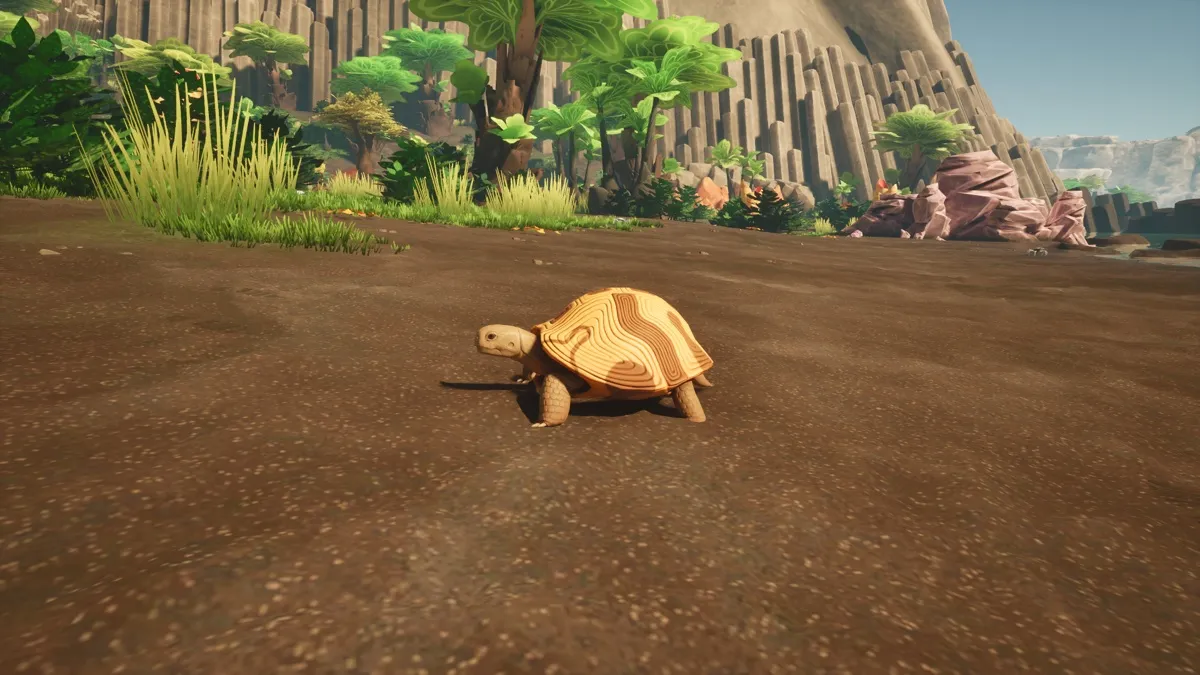
Why scan the Woodback Tortoise first in the Headlands?
Because the Headlands is classified as mixed danger, and the tortoise is the zone’s pressure valve. While the Imperial Strider bolts at the first wrong step and the Bronze Wox answers threats with coordinated pack defense, the Woodback Tortoise is docile, slow-moving, and predictable — one of the more cooperative subjects in the zone. The official SOTA7 Field Survey Log #3 recommends it in almost exactly those words, and for a researcher stepping up from the Valley, that matters: you want at least one species you can study at leisure while you learn the terrain.
What do you actually learn from it?
This is not a filler catalogue entry. Documenting the tortoise provides useful insight into how the ecosystem sustains itself across rugged terrain — a slow, stationary animal surviving in a zone of stone formations and ruins says something concrete about food chains and shelter, and the survey log frames it exactly that way. For players following the research-first progression laid out in the getting-started guide, it is one of the cleanest data-per-effort ratios in the game.
How do you find one?
- Rugged ground. The tortoise is a resident of the Headlands proper — second-zone terrain described in the Sota7 zones guide.
- Predictable patterns cut both ways. Its routine makes it easy to locate and easy to re-find; once you have mapped one tortoise’s range, you have effectively mapped a reusable observation post.
- No approachcraft needed. Unlike the shy Wild Green Zuma back in the Valley, there is no stalking phase. Walk up, scan, observe.
Is there any risk?
Effectively none. The survey log’s line — “not every creature here demands caution; some are simply waiting to be studied” — is written about the tortoise and its harmless neighbor the Flux Beetle. The only real mistake is treating the whole zone like it is this safe: the Headlands’ flora alone includes species that are poisonous when consumed raw, a full breakdown of which lives on the flora hub.
Where does it sit in the wider roster?
The tortoise is the Headlands’ counterpart to the Valley’s friendly tier — the Lucuma Camilla school of easy subjects — and a deliberate contrast point within its own zone. Cataloging it alongside the Strider and the Wox in one expedition gives you the full temperament spectrum the creatures hub organizes the game around, and finishes your foundational Headlands research before the Pass demands everything you have learned.
Gallery
Related Articles
More from the field survey
guides
Honeycomb: The World Beyond Composter Guide: Biomass from Plant Matter
The Composter in Honeycomb: The World Beyond — how the Second Life quest's biomass loop works, what to feed it, and what the biomass is for.
guides
Honeycomb: The World Beyond Hoverboard Guide: Unlock, Controls & Durability
The hoverboard in Honeycomb: The World Beyond — how to unlock it, how it handles on Sota7, and how its durability scales with difficulty.
guides
Honeycomb: The World Beyond Storage & Rotting Guide: Containers & Fridges
How food rotting works in Honeycomb: The World Beyond — containers slow decay to 15%, powered fridges stop it entirely, and difficulty scales spoilage.
Was this helpful?
Thanks for the feedback!